Entrance / Financial art
For collectors · by Coldie
Financial art, made of the thing itself
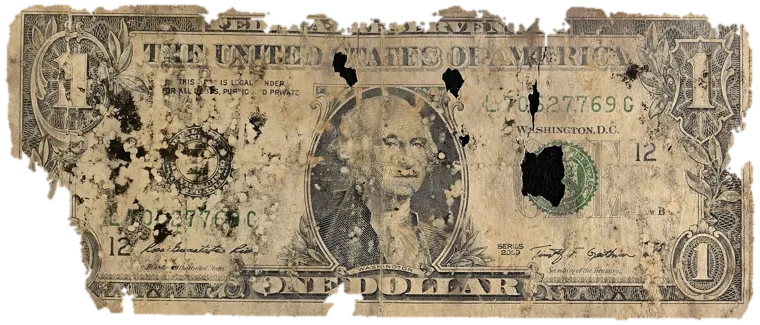
Financial art is work that uses money as its material, not as its subject. These pieces are made from real United States one-dollar bills that I buried in 2020 and dug up two years later, destroyed by water, soil and mold. The notes were graded and sealed by PMG, catalogued bill by bill, and the resulting works have hung at Christie's in New York. Prints start at $500. Originals start at $10,000, and commissions are open.
Most finance art is a picture of money. This is money.
Search for art for a trading floor and you get charging bulls, skyline silhouettes and the word HUSTLE in a serif font. That work decorates a room. It does not say anything that the people in that room do not already know.
These bills carry an argument instead. A dollar is a promise printed on cloth, and the ground did to one hundred percent of mine what inflation does slowly to all of it. Hang one in a place where money is managed and it reads as a position: that you know the difference between value and the paper that represents it. That is a quieter kind of status than a gold bull.
What is available
Filthy Fiat Flag. The American flag with the Bitcoin logo, composed from high-resolution scans of the buried bills. Archival pigment print on Hahnemuhle photo rag, 18 by 24 inches, edition of 21, debuted at Bitcoin 2025 in Las Vegas. $500. Acquire it here.
Originals and 1/1 works. Warren Buffett · Filthy Fiat, a portrait of the most famous investor in America assembled entirely from fragments of the buried bills, sold at Christie's New York in First Open: Post-War and Contemporary Art, lot 286. The fragments are magnetic on Dibond, so the work never hangs the same way twice. Original works start at $10,000 and are made one at a time.
Commissions. I take them. Scale is decided piece by piece, against the wall it is going on, and the honest timeline is about a year from agreement to delivery. That is what it takes to work this material: the supply of bills is finite, each one is separated by hand, and nothing can be reprinted if it goes wrong.
Studio editions. Signed prints from my wider practice, on archival Hahnemuhle rag:
- Michael Saylor Decentral Eyes · $300
- Edward Snowden Stereoscopic 3D Lenticular · $200
- Jack Dorsey Decentral Eyes 3D Magnetic Portrait · $175
- Edward Snowden Decentral Eyes Shirt · $25
Framed or unframed. I can frame and ship, or send the work unframed. My recommendation: take it unframed unless you want me to handle the install. Rolled or flat in an archival sleeve, a print travels better and costs less to ship, and you get to match the moulding to the room it is going in, which matters more in a designed office than any choice I would make from here. If you would rather it arrive ready to hang, say so and I will quote the framing. Ask your framer for anti-reflective glazing, an acid-free mat, and spacers so nothing presses on the print.
Checkout runs on Shopify. For anything above the editions, or for a work sized to a specific wall, the conversation starts by email.
Provenance, and proof you can check
Art made of currency invites one obvious question: is any of this real? Everything here is verifiable without taking my word for it.
- Third-party graded. Every bill was authenticated and encapsulated by PMG, the paper money grading service, with a certification number you can look up.
- Publicly catalogued. All 50 whole notes are listed with serial, Federal Reserve district and decay measurements in the registry.
- Individually checkable. Type a serial or certification number into the verifier and the record comes back.
- Auction record. The Buffett portrait sold at Christie's, lot 286.
The damage is the edition. No two notes decayed alike, nothing can be reprinted, and the serial number is the certificate of authenticity. The whole story is here, including the part where my bank called the money a biohazard.
Acquire, or ask
Prints are one click away on Shopify. Originals start at $10,000, commissions take about a year, and both begin the same way: email coldieart@gmail.com and tell me the wall. I answer these myself.
Acquire the Flag · $500 Inquire about an original or commission
Questions collectors ask
What is financial art?
Art about money and value. The term usually covers pictures of markets: bulls, charts, skylines. This project takes it literally and uses the currency itself as the material, so the work is made of the thing it is about.
Are the prints signed and editioned?
Yes. The Filthy Fiat Flag is an edition of 21 on Hahnemuhle photo rag, and the studio prints are signed editions on the same archival paper.
Is the money real, and is it legal to use it this way?
The bills are genuine United States one-dollar notes. They were destroyed by burial, not by me: two years in wet ground left them unspendable, and a bank refused them as contaminated. The work preserves what was left rather than defacing circulating currency.
How do I know a bill is what you say it is?
Every note was graded and sealed by PMG with a certification number, and the whole collection is published with serials, districts and decay measurements. You can look any of them up on the verify page before you buy anything.
Has the work sold at auction?
Yes. Warren Buffett · Filthy Fiat, a portrait built from fragments of the buried bills, was offered at Christie's New York in First Open: Post-War and Contemporary Art, lot 286.
How much do original works cost?
Originals start at $10,000. Prints are the other end of the range: the Filthy Fiat Flag is $500 in an edition of 21, and studio editions run from $25 to $300.
Do you take commissions, or make work for an office?
Yes. Scale is decided project by project, against the wall the work is going on, and the timeline is about a year from agreement to delivery. The bills are a finite supply separated by hand, so the work cannot be rushed or reprinted.
Do prints arrive framed?
Your choice. I can frame and ship, or send the work unframed in an archival sleeve. Unframed is usually the better buy: it ships cheaper and safer, and you can match the frame to the room. Ask your framer for anti-reflective glazing, an acid-free mat and spacers so the glass never touches the print.
The doorway
Every work on this page comes out of one box of buried money. The notes themselves are catalogued downstairs.
See what nature made of them