Education wing · by Coldie
Why do banks refuse damaged or moldy money?
Banks refuse moldy money because the Federal Reserve officially classifies mold as contamination. Contaminated currency cannot go through a normal deposit: it must be double-bagged in tamper-evident clear bags marked CONTAMINATED, declared to the Federal Reserve in writing before it arrives, and once received it is destroyed, never recycled. A teller window is not equipped for any of that, so the practical answer at the counter is no.
I know this rule the hard way. In 2022 I carried a brick of 200 moldy one-dollar bills into my local Chase branch and asked to trade them for fresh ones. The manager ran over with his hands in the air: "You need to get out of here right away. That is live mold and a biohazard." You can read that whole scene in the story.
He was not making it up. The Federal Reserve's cash rules say that prolonged exposure to water that results in mold makes currency contaminated. Wet money that has not molded yet is fine: dry it and deposit it normally. Once mold appears, the note enters a different world:
It must be sealed in two clear, tamper-evident currency bags. The outer bag must say CONTAMINATED in large permanent marker. The bank must notify its Federal Reserve cash office in writing, describing the contamination, before sending it. Deposits that skip any of this are refused and returned. And contaminated notes are never cleaned and recirculated: they are destroyed under controlled conditions.
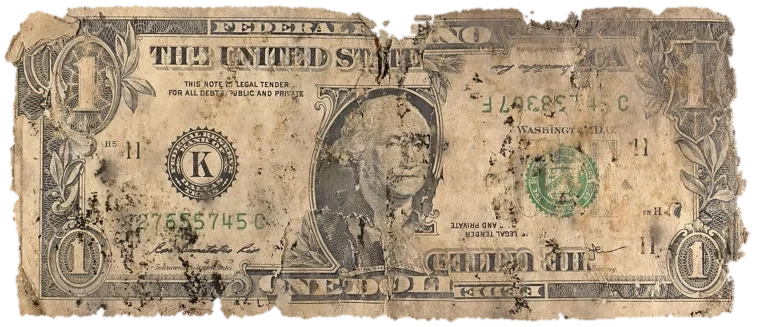
So the teller was not being dramatic, or not only dramatic. Mold on cash is alive, it spreads by spores, and the person at the window has no double bags, no notification forms, and no reason to open your zip-lock. The system for moldy money exists, but it runs between institutions, not across the counter.
If your moldy money is also falling apart, a second program applies: the Treasury's mutilated currency redemption, which I have written about separately, including the part where the promised exchange bag never came.
Related questions
Is a bank allowed to refuse my damaged cash?
Yes. A bank is not required to accept currency it considers contaminated or unidentifiable at the counter. Its own path for moldy money runs through the Federal Reserve's special contaminated-currency process, not through a normal deposit.
What officially counts as contaminated currency?
Currency damaged by or exposed to something that poses a health or safety risk. The Federal Reserve's guidance names mold from prolonged liquid exposure specifically. Wet but unmolded money is not contaminated; dry it and deposit it normally.
Does the Federal Reserve clean and reuse moldy bills?
No. Contaminated currency is not recycled back into circulation. After verification it is destroyed safely.
What should I do if my cash got wet?
Dry it before mold can start; then it can be deposited normally. If mold has already bloomed, talk to your bank about a contaminated-currency deposit, or the BEP's mutilated currency program if the notes are also physically broken down.
The doorway
Everything on this page is illustrated with real dollars that spent two years underground.
See what nature made of themSOURCES · Federal Reserve Financial Services: contaminated currency · Federal Reserve Bank of Boston on contaminated cash · UPDATED 2026-07-05