Education wing · by Coldie
Can you clean moldy money?
Not in any way that makes it safe. US currency is 75% cotton and 25% linen, a porous fabric that mold grows into, and the EPA warns that moldy porous materials often can't be fully cleaned. Killing the mold isn't enough either, because dead mold can still trigger allergic reactions. Scrubbing tears fibers the mold has already weakened, and the Boston Fed warns that laundered cash can wrongly flag as fake. The right move is the official one: seal it in a plastic bag and take it to a bank as contaminated currency, or send notes that are falling apart to the Treasury.
Search this question and you'll find cheerful guides to cleaning your cash at home. When I dug up my emergency box, what came out was 200 one-dollar bills fused into a thick white brick of mold. My plan was simple: take it to the bank and swap it for fresh bills. That went badly, but it taught me the answer to this question.
You can't clean moldy money. Here is why, and what to do instead.
Why cleaning doesn't work
Money is fabric, and mold grows into fabric. A dollar is 75% cotton and 25% linen, not paper. The EPA's own guidance on mold says absorbent, porous materials may have to be thrown away once they become moldy, because the growth works its way into the material instead of sitting on top of it. A bill is exactly that kind of material, just smaller and harder to replace.
Dead mold still counts. Say the bleach does kill every spore. The EPA is blunt about what that buys you: dead mold can still cause allergic reactions, so killing it is not enough, it has to be removed. On a sheet of woven cotton, you can't remove what has grown into the weave.
Bleach isn't the fix people think it is. The EPA does not recommend chlorine bleach or other biocides as a routine part of mold cleanup, and it warns never to mix bleach with ammonia cleaners because the fumes are toxic. That is a lot of risk to take for a stack of ones.
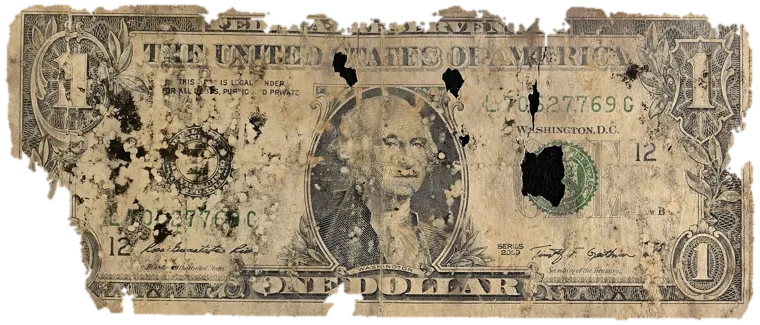
The washing machine myth
Plenty of people have run a twenty through the laundry and spent it anyway. Cloth survives a wash. But a wash is not a cure: the Boston Fed warns that laundered money can wrongly come up as fake when a cashier checks it with a counterfeit detector pen, and nothing about warm water pulls spores back out of the fibers. You end up with a cleaner-looking bill that is still moldy and now looks suspicious.
Even the Federal Reserve doesn't wash money. Its processing machines have sensors that measure how soiled a note is, and notes that fail are shredded on the spot. The system that cares most about keeping cash usable answers dirty money with a shredder, not a sink.
What I learned taking a brick of it apart
Taking my brick apart taught me how fragile moldy money is. Under a mask and gloves, with spores springing into the air, I found that any amount of force tore the notes. The only way in was an x-acto blade slid between the layers with a slight twist, one bill at a time. Some separated whole. Others came apart in fragments. The mold was no longer on the money. It was part of it.
By then I had already stopped thinking of them as cash. The full account is in the story.
What to do instead
1. Handle it as little as possible. The EPA's advice for anyone near mold is gloves, goggles and an N-95 respirator. Don't fan through the stack or count it out. Here is why the spores matter.
2. Seal it in a plastic bag. If it is wet but not moldy yet, dry it fast instead: the EPA says water-damaged things should be dried within 24 to 48 hours to prevent mold from taking hold.
3. Take it to your bank and use the words "contaminated currency." The Federal Reserve's definition of contaminated currency specifically includes mold from prolonged exposure to water. According to the Boston Fed, banks double-bag it, notify the Fed that it's coming for special handling, and give you credit for the deposit.
A warning from experience: not every branch knows that. My bank manager ran over with his hands in the air and told me to get out because my cash was live mold and a biohazard. The process exists. Ask for it by name, and if one branch panics, try another. More on why banks balk at moldy cash.
4. If it is falling apart, send it to the Treasury. Notes that are brittle, fused or in pieces go to the Bureau of Engraving and Printing's mutilated currency program, which is free. Its packing rules are the opposite of cleaning: don't disturb the fragments any more than necessary, pack brittle currency in cotton, leave it in the container it was found in if you can, and never tape, glue or laminate it.
Or, if you are me, you have it graded, sealed in a holder, and call it art.
Related questions
Does bleach kill mold on money?
It may kill mold on the surface, but that doesn't make the bill safe. The EPA doesn't recommend bleach as a routine mold fix, dead mold can still cause allergic reactions, and on a porous cotton-linen note there's no way to know you reached all of it.
Can I put moldy money in the washing machine?
It will probably survive, because currency is cloth, but it won't be clean in any way that matters. The spores stay in the fibers, and the Boston Fed warns that laundered bills can wrongly test as fake with a counterfeit detector pen.
Can I just let moldy money dry out?
Drying stops mold from spreading, which helps if the bills are only damp. It doesn't remove mold that's already there, and handling a dry moldy note still releases spores. Bag the bills and take them to a bank as contaminated currency.
Will my bank exchange moldy money?
It should. The Federal Reserve has a contaminated currency process for exactly this, and the Boston Fed says banks give customers credit for the deposit. Branch staff don't always know it, so ask for contaminated currency handling by name.
What if the moldy bills are falling apart?
Send them to the Bureau of Engraving and Printing's mutilated currency program, which examines and redeems damaged notes free of charge. Pack them as found, disturb the fragments as little as possible, and include the required BEP form.
Keep reading
The doorway
Everything on this page is illustrated with real dollars that spent two years underground.
See what nature made of themSOURCES · EPA: a brief guide to mold, moisture and your home · Boston Fed: got dirty money? don't count out contaminated cash · Boston Fed: how the Fed keeps cash clean · Federal Reserve Financial Services: contaminated currency · BEP: mutilated currency packing directions · UPDATED 2026-09-14