Education wing · by Coldie
Is moldy money safe to handle?
Treat moldy money with real caution. The mold is alive and spreads by spores, which is why the Federal Reserve formally classifies moldy currency as contaminated and requires sealed double-bag handling. For most healthy people, brief contact is unlikely to cause harm, but spores can trigger allergies and asthma, and people with weakened immune systems or lung conditions should not handle it at all. If you must handle it: gloves, a mask, a ventilated space, sealed bags, washed hands. This is general information, not medical advice.
I spent weeks with a brick of it. Mask on, gloves on, sliding an x-acto blade between moldy layers while spores sprang into the air and I quietly wondered whether the mask and gloves were enough. (They were, as far as I can tell. The story of that surgery is here.)
What I learned, and what the official handling rules imply:
Mold on a bill is not a stain, it is a colony. US currency is 75% cotton and 25% linen, an organic fabric that holds moisture, which makes a wet stack of bills a good meal. Disturbing a moldy note releases spores, and inhaled spores are the actual risk: mostly allergy and asthma triggers, more serious for immunocompromised people.
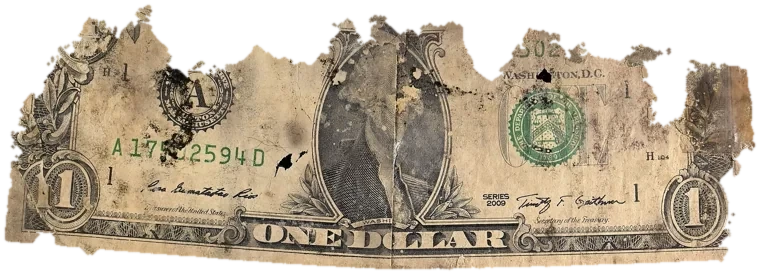
That is why the Federal Reserve's own staff never receive moldy notes loose: they arrive double-bagged in clear tamper-evident bags labeled CONTAMINATED, with written notice ahead of them, and after verification the notes are destroyed rather than recirculated. When a system that counts money for a living refuses to breathe near it, take the hint.
In this collection the mold is sealed away: every bill was graded and encapsulated in a PMG holder, which is how you can look at the bloom without sharing a room with it.
Related questions
Can I clean or disinfect a moldy bill?
Not reliably, and washing destroys the note further. There is no approved home method for sanitizing currency; the system's answer is exchange and destruction, not cleaning.
Can I still spend moldy money?
Merchants and banks can refuse it, and banks generally will, because moldy currency is classified as contaminated. The practical routes are the contaminated-currency process through a bank or the BEP's mutilated currency program.
Why does money mold in the first place?
Because it is cloth, not paper: 75% cotton and 25% linen. It absorbs and holds moisture, and damp organic fiber is exactly what mold eats.
How is this collection safe to own?
Each bill is sealed inside a PMG grading holder. The specimens are studied through scans and the encapsulated notes, not by handling raw moldy currency.
The doorway
Everything on this page is illustrated with real dollars that spent two years underground.
See what nature made of themSOURCES · Federal Reserve Financial Services: contaminated currency · UPDATED 2026-07-05