Education wing · by Coldie
How dirty is the money in your wallet?
Very. Peer-reviewed studies have found around 3,000 species of bacteria living on $1 bills, cocaine traces on up to 90% of US notes, fecal bacteria including E. coli on a large share of currency, and influenza virus surviving up to 17 days on a banknote. Cash is one of the most-handled objects in daily life, and it carries a moving record of every hand, pocket and counter it has touched. The traces are usually minute and handling money is not considered a major health risk, but the point stands: money is filthy long before anyone buries it.
Filthy Fiat is named for the obvious filth: two years of mold, rust and rot you can see across the collection. But the unsettling part is that a crisp, clean bill straight from an ATM is already filthy in ways you cannot see. Scientists have been measuring it for years.
The bacteria. New York University's Dirty Money Project sequenced the DNA on $1 bills from a Manhattan bank and identified roughly 3,000 types of bacteria, far more than anyone had counted under a microscope, and could only match about 20% of the DNA to known organisms. Most are harmless. A minority are not. Some of the named organisms found living on US currency:
A sample of what has been found living on US bills
| Organism | Associated with | Note |
|---|---|---|
| Cutibacterium acnes (Propionibacterium) | Acne, skin | The most abundant species identified on $1 bills |
| Streptococcus oralis | Mouth, dental plaque | Among the most common organisms found |
| Escherichia coli | Food poisoning, diarrhea | Fecal indicator; detected on up to ~55% of US notes |
| Staphylococcus aureus (incl. MRSA) | Skin infections | Antibiotic-resistant strains found on US bank notes |
| Salmonella | Food poisoning | Shown to survive on coins and ATM surfaces |
The drugs. A 2009 study presented to the American Chemical Society tested 234 banknotes and found cocaine on up to 90% of US bills, picked up during deals and from rolled bills used to snort it, then spread note-to-note inside counting machines. It varied by country:
Cocaine traces on banknotes, by country (2009)
Cocaine is only the headline. When a forensic study screened US $1 bills for a panel of drugs, it found more than one:
Drugs detected on US $1 bills
| Substance | Detected on | Amount per bill |
|---|---|---|
| Cocaine | 92% of bills | trace to heavy |
| Heroin | 7 of 10 | 0.03 to 168.5 µg |
| 6-acetylmorphine (heroin marker) | 3 of 10 | trace |
| Morphine | 3 of 10 | trace |
| Methamphetamine | 3 of 10 | trace |
| Amphetamine | 1 of 10 | trace |
The gut bacteria. Because money travels from hands to pockets to counters, it also carries what hands carry. Reviews of currency studies report E. coli, the fecal indicator bacterium, detected on anywhere from 1-2% of notes in some countries to around 55% in US samples, along with Pseudomonas and other pathogens. And influenza virus, in one Applied and Environmental Microbiology study, stayed infectious on banknotes for up to 3 days on its own and up to 17 days when mixed with respiratory mucus.
And everything else. The same DNA sequencing that counted the bacteria also picked up what money quietly ferries between hands:
- Human DNA, from skin cells and hair, on essentially every bill
- DNA from domestic animals, the pets and livestock that shared a hand or a pocket
- Bacteria tied to specific foods, a quiet record of what the last handlers ate
- Dirt, skin cells and environmental grime, the ordinary residue of circulation
- Drug and, at times, virus traces, as the tables above show
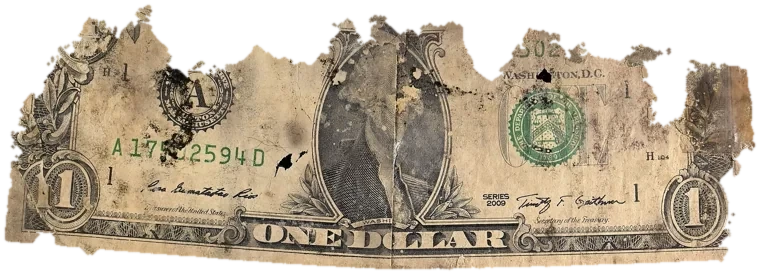
The honest part. None of this means cash will make you sick. The cocaine amounts are often vanishingly small, thousands of times smaller than a grain of sand, and a virus surviving on a surface is not the same as it reaching you: it lives on skin only minutes, and people handle money safely every day. This is not a scare. It is a fact about what money is: the most-handled object most of us touch, a shared surface that records everyone who came before.
Which is the whole idea behind this collection. These 64 bills did not invent filth. They took the invisible, everyday griminess of circulating money and let water, dirt and time turn it into something you can finally see, measure and hang on a wall. The mold you can see is just the honest version of the bacteria you cannot.
Related questions
Can you get sick from handling money?
For most healthy people, the risk is low. Studies find plenty of bacteria and occasional viruses on cash, but detection is not the same as infection, and the amounts are usually tiny. Washing your hands after handling money and before eating is sensible, ordinary hygiene, not cause for alarm.
Why does cash carry so much cocaine?
Bills are used directly in drug deals and, notoriously, rolled up to snort powder. Once even one contaminated note enters a bank's high-speed counting machine, it transfers trace cocaine to many others, which is how up to 90% of US bills end up testing positive from a small number of heavily contaminated ones.
Is a fresh bill from the ATM clean?
Cleaner, but not clean. New notes carry fewer microbes than worn ones, but ATMs themselves have been found to carry bacteria, and a note joins circulation quickly. The general finding is that the older and more worn a bill is, the more it carries.
Are polymer (plastic) banknotes cleaner than cotton ones?
Some studies suggest smoother polymer notes host fewer bacteria than porous cotton-linen notes, which is one argument countries make for switching. The US still prints on a cotton-linen blend, the same absorbent fabric that let these buried bills soak up two years of mold.
Does this collection expose me to those contaminants?
No. Every bill is sealed inside a PMG grading holder, and the specimens are studied through scans and the encapsulated notes, never by handling raw currency.
The doorway
Everything on this page is illustrated with real dollars that spent two years underground.
See what nature made of themSOURCES · NYU Dirty Money Project / metagenomics of NYC currency (PMC) · Scientific American: cocaine contaminates majority of US currency (Zuo, 2009) · Drug contamination of US paper currency (Forensic Science International, 2001) · Money and transmission of bacteria (review, PMC) · Survival of influenza virus on banknotes (Applied and Environmental Microbiology) · UPDATED 2026-07-05