Education wing · by Coldie
What does it mean when a dollar's serial numbers don't match?
Every US bill carries its serial number twice, upper right and lower left, and the two should be identical, just as the serial's district letter should agree with the Federal Reserve seal on a $1 bill. When the serials differ, you are holding a mismatched-serial error note: a genuine printing mistake, rare because inspection is designed to catch it, and prized by collectors for exactly that reason. Any such find should be authenticated by a third-party grading service before anyone calls it an error.
Serial numbers are stamped by numbering machines late in the printing process, two impressions per note. Each machine is a set of rotating digit wheels, and when one wheel sticks or jumps on one of the two impressions, the note leaves the press disagreeing with itself. Inspection catches nearly all of them and replaces them with star notes, which is why survivors are scarce and why collectors pay real premiums for them.
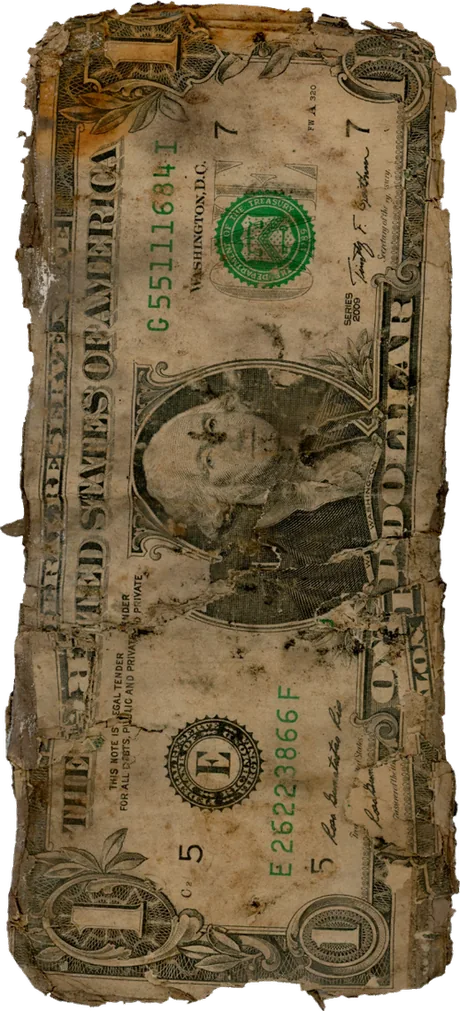
Which brings me to the bill this whole project orbits. The flagship specimen, Series 2009, spent 24 months underground beside the silver and the .38 rounds. Its Federal Reserve seal reads E, Richmond, District 5, and its lower serial E26223866F agrees. Its upper serial reads G55111684I with a corner 7: Chicago. Same note, two birthplaces.
I frame it exactly as carefully as it deserves: a district anomaly that needs physical verification, not a certified error note. Decay has rewritten a lot of this bill, and extraordinary claims about extraordinary objects should go through the graders, not through my enthusiasm. Until then it stands as the collection's thesis in miniature: the serial number is the code of authenticity, and this one returns two answers. Verification is not a footnote to this project. It is the project.
Related questions
Are error notes valuable?
Often, yes. Values depend on the error type, its visibility and the note's condition. Mismatched serials, dramatic misprints and fold-over errors regularly sell for many multiples of face value, but authentication comes first.
How do I check my own bill?
Compare the two serial numbers character by character, then check that the serial's first letter matches the seal letter and corner numbers on a $1 bill. Most mismatches people find are misreadings of worn ink, so look twice.
What should I do if I find a real mismatch?
Handle it as little as possible and submit it to a third-party grading service such as PMG for authentication. A certified error is worth far more than a claimed one.
Is the Filthy Fiat flagship a certified error note?
No, and the project deliberately does not call it one. It is presented as a district anomaly pending physical verification. The measured facts are on its record; the verdict belongs to the graders.
The doorway
Everything on this page is illustrated with real dollars that spent two years underground.
See what nature made of themSOURCES · PMG: about paper money grading · UPDATED 2026-07-05