Education wing · by Coldie
Is it illegal to deface money to make art?
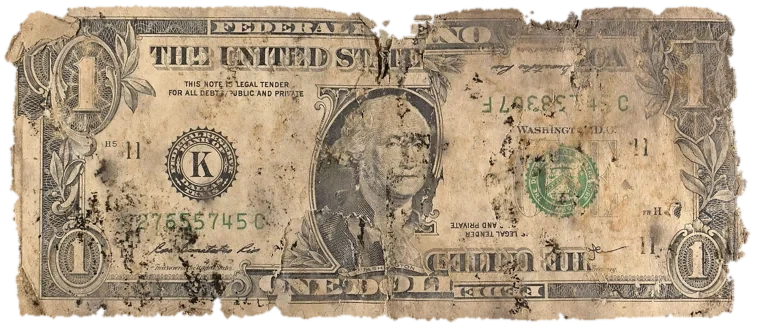
Under federal law (18 U.S.C. § 333), defacing a Federal Reserve note is a crime when it is done with intent to render it unfit to be reissued. The law is about intent: deliberately cutting, gluing, perforating or ruining a bill so it can't circulate. Filthy Fiat is the opposite case. I buried 200 dollars to keep them, nature ruined them without my knowing, the bank refused them as a biohazard, and the Treasury's exchange never came through. Since then my whole job has been preservation: separating the notes by hand, keeping them as intact as possible, and having them graded and sealed by PMG.
What the law actually says
The statute people mean when they say "it's illegal to deface money" is 18 U.S.C. § 333. It covers anyone who mutilates, cuts, defaces, disfigures, perforates, or unites or cements together a bank bill or Federal Reserve note, or does anything else to it, with intent to render it unfit to be reissued. The penalty is a fine, up to six months in prison, or both.
Two things matter in that sentence: an act, and a purpose. The law is aimed at someone who sets out to take a working bill out of circulation by damaging it. It is not a law against money getting old, wet, moldy or unlucky. If it were, every flood, house fire and forgotten coffee can would be a federal case, and the Treasury wouldn't run a free program to redeem mutilated currency.
Nobody set out to ruin these bills
In 2020 I buried a box in my parents' backyard as an emergency stash: 200 one-dollar bills, two silver bars, a gold coin, family photos. The whole point was that the money would still be spendable on the worst day of my life. I duct-taped the box and wrapped it in another bag to keep water out. That is not the behavior of someone trying to make cash unfit for use. It is the behavior of someone who very much wanted his cash to work.
Two years later I dug it up and found water and dirt had gotten in anyway. The stack had become a single white brick of mold. I did not do that. Time, water, soil and iron did that, in the dark, with nobody watching. The full account is in the story, and the science of what happens down there is in what happens to money buried underground.
I tried to cash them in first
My first move was the most boring, law-abiding one possible: I took the brick to my bank to trade it for fresh bills. The manager ran over with his hands up and told me to leave, because it was live mold and a biohazard. That is not a bank being dramatic. The Federal Reserve classifies moldy cash as contaminated currency, with handling rules no teller window is built for.
The manager took my information so the Treasury could send me a bag for the official mutilated currency exchange. That bag never arrived. So I was holding 200 dollars that the bank wouldn't touch and the government never collected. The bills were already out of circulation before I made a single artistic decision about them.
The surgery: separation, not destruction
When I finally opened the brick, I did it with a mask, gloves and an x-acto blade, the way a conservator would, not a vandal. The notes were so fragile that any force tore them, so I worked the blade slowly between layers to lift one bill off the next. The goal every time was to free as much of each note as possible, whole.
Some came apart cleanly. Others had fused so completely that pulling them apart would have destroyed both, so I left them joined, exactly as found. A few broke during extraction no matter how careful I was; those partial notes are held out of the main registry and recorded honestly, missing pieces and all. Nothing was trimmed to look better, painted, punched, written on or glued. Every stain, hole and fusion you see is the ground's work, and the measured damage on each record is what was there when it came out.
Preserved, not destroyed
Here's the part I'm proudest of. Instead of letting these notes crumble or end up shredded, I send them to PMG, the independent service that authenticates and grades paper money. Every whole note I have extracted so far has been graded and sealed in an archival holder with its own certification number, and the rest of the brick follows the same path as it comes apart. Anyone can look up any of those numbers in PMG's public database. You can do it right here on the verify page.
That holder is the opposite of mutilation. It freezes the note in the state nature left it, protects it from any more handling, and puts a neutral third party's name on what it is: a genuine United States one-dollar Federal Reserve note, serial number and all. Every bill in Filthy Fiat is still a legal-tender dollar. It is just a dollar with a story nobody else's has.

The fragments are pictures, not pieces
Filthy Fiat also has a fragment side: grids of cells, seal templates, portraits built from tiny tiles of bills. None of that involves cutting a physical note. Every fragment is a crop of a high-resolution scan. The real bills stay whole in their PMG holders while the digital work happens on their photographs.
Why this is what makes the art matter
Lots of artists have made work out of money: folded, collaged, burned, shredded, stamped. That work is about what the artist did to the dollar. Filthy Fiat is about what the world did to it while nobody was looking. I didn't author the damage. I authored the conditions by accident, then the rescue, the selection and the record.
That's why I call it a generative collection minted by nature. Time plus water plus dirt is the algorithm. The decay on each note is its metadata. The serial number is its proof of authenticity, and PMG's certification is the chain of custody. If I had taken a blade or a torch to these bills on purpose, they would be just another stunt. Because I didn't, each one is a true artifact: 1/1, unrepeatable, and honest about every mark on it.
This page describes how the collection was made. It is my account of the facts, not legal advice.
Related questions
Is it illegal to make art out of dollar bills?
Federal law (18 U.S.C. § 333) makes it a crime to deface a bank note with intent to render it unfit to be reissued. Whether a specific artwork crosses that line depends on what was done and why. Filthy Fiat's bills were damaged by nature while buried as savings, then preserved, so the defacing was never anyone's intent.
Did Coldie cut or alter the Filthy Fiat bills?
No bill was cut to shape, painted, punched, written on or glued. The notes were separated from a fused, moldy brick by hand, working a blade between layers, and notes that had fused together were kept together as found.
Are Filthy Fiat bills still real money?
Yes. Each is a genuine US one-dollar Federal Reserve note. Every whole note extracted so far has been authenticated and graded by PMG and sealed in a holder with a certification number anyone can look up.
Why not just exchange the moldy bills with the Treasury?
That was the first plan. The bank refused the brick as a biohazard, and the exchange bag the Treasury was supposed to send never arrived. The bills were out of circulation long before they became art.
Are the digital fragments cut from real bills?
No. Fragments are crops of high-resolution scans. The physical notes stay whole in their PMG holders.
Keep reading
The doorway
Everything on this page is illustrated with real dollars that spent two years underground.
See what nature made of themSOURCES · 18 U.S.C. § 333: mutilation of national bank obligations (Cornell LII) · BEP: mutilated currency redemption · Federal Reserve Financial Services: contaminated currency · PMG: paper money grading and cert lookup · UPDATED 2026-10-20