Education wing · by Coldie
What happens to money buried underground?
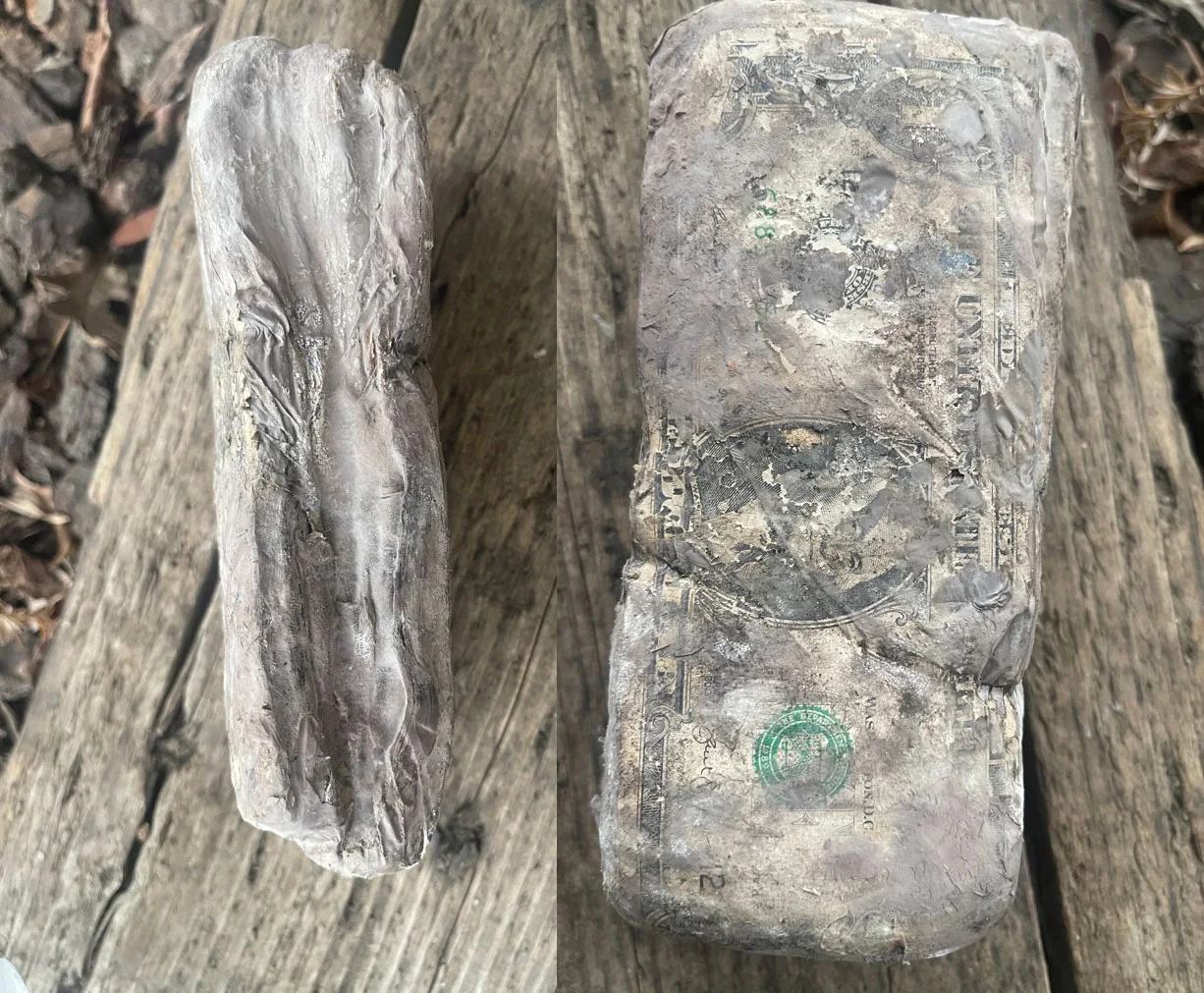
Paper money does not survive underground for long. A dollar is 75% cotton and 25% linen, a plant-fiber fabric, and once moisture reaches it, mold and microbes start breaking it down. I buried 200 one-dollar bills in a duct-taped box wrapped in a bag, and two years later water and dirt had found their way in and the stack had become a single brick of mold. Of the 64 bills I later had graded, every one carried mold, soil and water staining, the typical note had lost about a quarter of its material, and three had lost their serial numbers entirely. The Treasury does consider redeeming money damaged by burial.
What I buried, and what came back
In 2020, as part of my emergency preparation in fire country, I buried a box of things that could get me through a few bad days: 200 one-dollar bills, two five-ounce silver bars, a small gold coin, .38 caliber rounds, family photos and a pair of paper 3D glasses. I duct-taped it and wrapped it in another bag to keep it dry.
Two years later I got curious whether I had buried it correctly, and spent about 30 minutes digging in my parents' backyard to find out. Water and dirt had gotten inside. The money was no longer a stack of bills. It was a thick white brick.
Good thing I didn't discover that during an actual emergency. I would have been totally screwed.
Why paper money rots in the ground
Money is food. A dollar is cotton and linen cloth, and plant fiber is exactly what fungi and soil bacteria live on. Laboratory soil-burial studies, the tests textile makers use to measure rot, show plain cotton fabric visibly breaking down within weeks of contact with damp soil, and one study measured cotton fabrics losing close to 90% of their weight in four months.
Water flips the switch. The EPA puts it simply: the key to mold control is moisture control, and no mold will grow without water. Mold spores are already floating in ordinary air and dust, so any container sealed with them inside only needs moisture to start a colony. Mine had duct tape and a bag between the money and the ground. Water got in anyway.
Then time does the rest. Wet bills pressed together stay wet, and mold growing through a stack binds the notes to each other. That is how 200 separate dollars became one object that I later had to open like a surgeon, sliding an x-acto blade between layers because any real force tore them. The full account is in the story.
What two years underground did, measured
Every graded bill in this collection has its decay scored from scans of the note, trait by trait. Across all 64:
- Mold on 64 of 64. A typical bill scores about 12% black mold, and the worst scores 28%.
- Dirt and soil on 64 of 64. Typically around 14% of the note, up to 27%.
- Water staining on 64 of 64. Typically about 13%, up to 35%.
- Iron oxide, the compound we call rust, on 34 of 64. Usually a trace, up to 10% of a note.
- Material lost on every single bill. Measured at the edges, the typical note is missing about a quarter of itself. 26 lost a quarter or more, and the worst lost 54%.
- Serial numbers gone entirely on 3 of 64. On those notes the one thing that makes a dollar a specific, traceable dollar was digested.
- Washington's portrait at least half disturbed on 17 of 64.
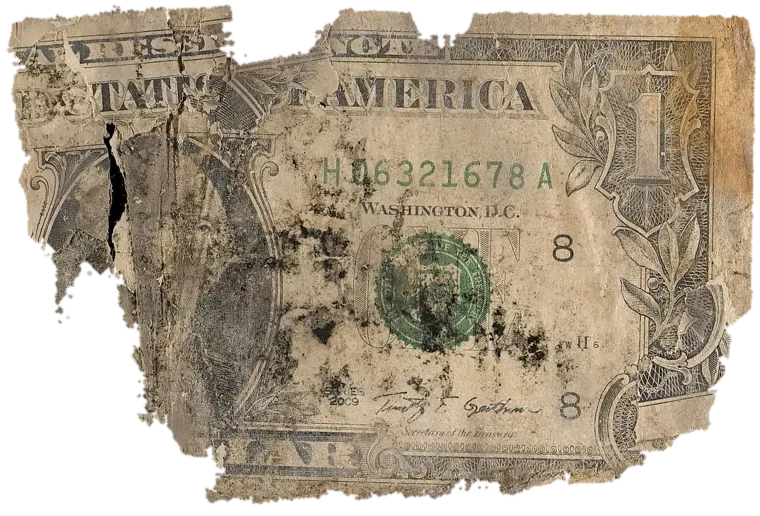
No two came out alike. Same box, same soil, same two years, and 64 different results. That randomness is why I treat the collection as generative art: time, water and dirt were the algorithm, and the damage on each bill is its record. You can inspect every one in the registry.
What survived
Cloth is stubborn. After two years inside a brick of mold, the 64 notes in this collection still held together well enough to be graded by PMG, the third-party paper money grading service. 61 of them still carry a readable serial number, and on the flagship specimen the words THIS NOTE IS LEGAL TENDER are still legible while nature edits everything around them. The mold rewrote the money, but it didn't fully erase it.
Can you still exchange money that was buried?
Often, yes. The Bureau of Engraving and Printing lists "deterioration by burying" among the kinds of damage its mutilated currency program handles, and the service is free. If clearly more than half of a note survives and is identifiable, it pays full face value. Here is how that process works.
If the buried money is also moldy, it counts as contaminated currency too, which changes how a bank should handle it and means you should not try to clean it first. My own bank called my brick a biohazard and sent me away, and the exchange bag the Treasury was supposed to mail me never arrived. Why banks react that way.
If you are thinking about burying cash
I can only tell you what happened to mine: a duct-taped, bagged box was not enough to keep water out of it. Whatever you bury, dig it up and check it long before you need it. I only found out because I got curious.
Related questions
How long does paper money last underground?
It depends on how much moisture reaches it. In lab soil-burial tests, plain cotton fabric in damp soil starts falling apart within weeks. My bills were in a taped, bagged box and lasted two years as a recognizable stack, but they came out as a brick of mold, and every one was damaged.
Does a sealed container protect buried money?
Only if water truly cannot get in. My box was duct-taped and wrapped in a bag, and water and dirt still got inside. Mold spores are already in ordinary air, so any moisture trapped with the money is enough for mold to grow.
Will the Treasury replace money that rotted underground?
It may. The Bureau of Engraving and Printing's mutilated currency program specifically covers deterioration by burying, free of charge. Notes with clearly more than half remaining and identifiable are redeemed at full value; for less, you must show the rest was destroyed.
Why did the bills stick together?
Wet bills pressed together stay wet, and mold growing through a stack binds the notes to one another. Separating them afterward is delicate work, because the weakened fibers tear with very little force.
Can you spend money that was buried?
If a note is intact and identifiable, it is still US currency. Badly damaged or moldy notes get refused, which is why they go through a bank's contaminated currency process or the BEP's mutilated currency program instead.
Keep reading
The doorway
Everything on this page is illustrated with real dollars that spent two years underground.
See what nature made of themSOURCES · BEP: mutilated currency FAQs (includes deterioration by burying) · EPA: a brief guide to mold, moisture and your home · Biodegradation behaviour of different textile fibres (soil burial study) · Biodegradation of natural textile materials in soil · Federal Reserve Financial Services: contaminated currency · UPDATED 2026-09-14