Education wing · by Coldie
What do all the letters and numbers on a dollar bill mean?
Every mark on a dollar bill is information. The round black seal left of the portrait names the Federal Reserve Bank that issued it, and its letter (A through L) is repeated as a number (1 through 12) four times near the corners. The green serial number, printed twice, starts with that same district letter on a $1 bill and ends with a block letter that advances as printings fill up. The series year is the design's birth year, not the print date. Small plate letters and numbers record which engraving plate printed it and where it sat on the sheet. And the two signatures belong to the Treasurer of the United States and the Secretary of the Treasury.
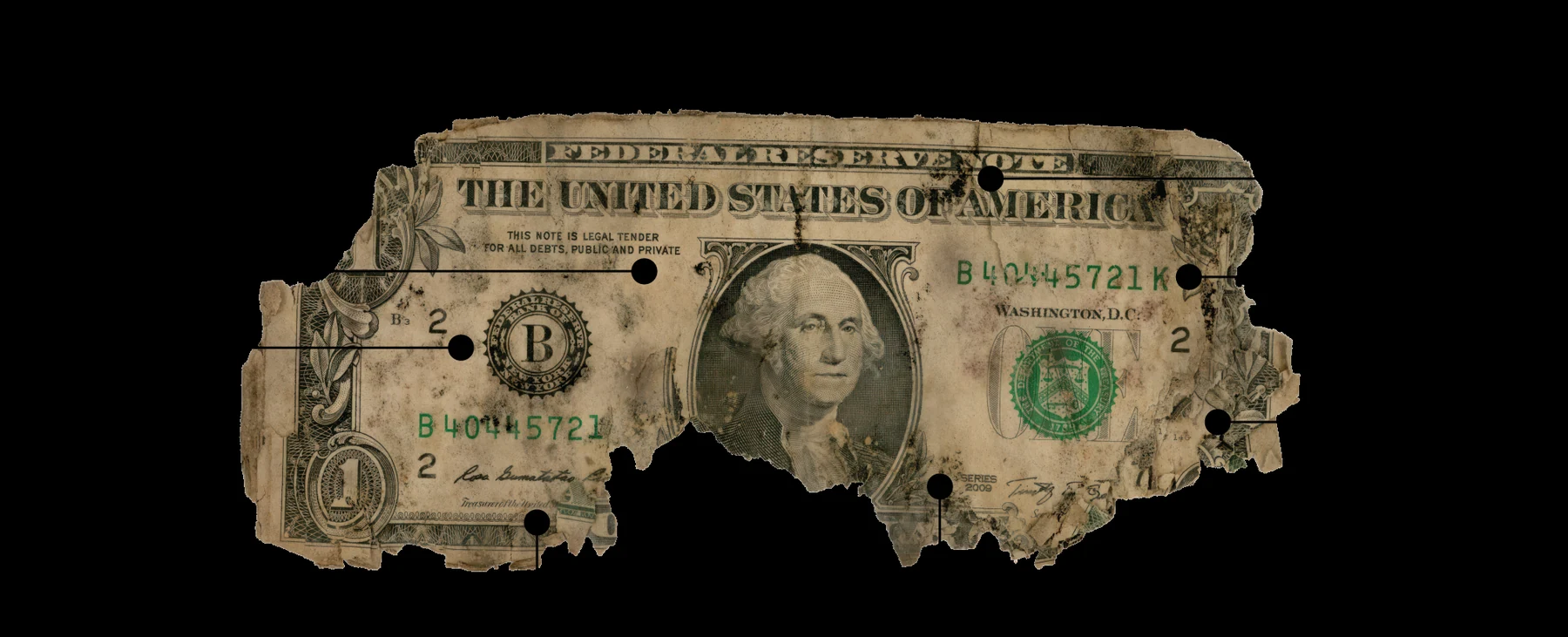
The fastest way to learn this is to do it: our check your bill page has a click-through version pinned onto a real specimen, plus a lookup that tells you which Federal Reserve Bank issued the dollar in your pocket.
A few details worth knowing beyond the pins:
The seal and serial must agree. On $1 bills the serial's first letter always repeats the seal's district letter. Our flagship specimen appears to break this rule, which is exactly why it is the flagship: the district anomaly story.
A star means a do-over. If the serial ends in a star instead of a letter, the original note failed inspection and this replacement was printed with a star so no serial number repeats. Collectors hunt them.
FW means Fort Worth. Notes printed at the Western Currency Facility in Fort Worth, Texas carry a small FW beside the face plate number. No FW means Washington, DC.
The series year is not the print year. It marks the design, and it changes when the design or the signatures change, which is why a "Series 2013" note may have been printed years later.
Related questions
Does the serial letter always match the seal letter?
On $1 and $2 bills, yes. On $5 and higher notes printed since 1996, the design uses a universal Federal Reserve System seal instead; the district appears as a small letter-number code on the face, and the serial's first letter marks the series instead.
What is a star note?
A replacement for a note that failed inspection. It reuses the failed note's serial number with a star at the end, because no two regular notes may share a serial.
What does a low or fancy serial number mean?
Nothing official, but collectors pay premiums for low numbers, ladders, repeaters and solid digits. On this project the serial is something more: the code of authenticity for each specimen.
Where is the plate position mark?
A small letter and number combination on the face (and a plate number on the back) recording which engraved plate and which sheet position printed the note.
The doorway
Everything on this page is illustrated with real dollars that spent two years underground.
See what nature made of themSOURCES · Bureau of Engraving and Printing · UPDATED 2026-07-05