Education wing · by Coldie
Treasury vs. Federal Reserve: who does what with your money?
They split the job. The Department of the Treasury is the government's finance office: it prints paper currency through its Bureau of Engraving and Printing (BEP), mints coins through the US Mint, collects taxes, and borrows for the government. The Federal Reserve is the central bank: it decides how much money should circulate, orders notes from the BEP, issues them into the economy through its 12 regional banks, and sets interest rates. Every dollar bill records the partnership: it is a Federal Reserve Note bearing the Treasury's green seal and two Treasury officials' signatures.
Your dollar is a two-signature contract between these institutions, and you can read the split right on the fabric:
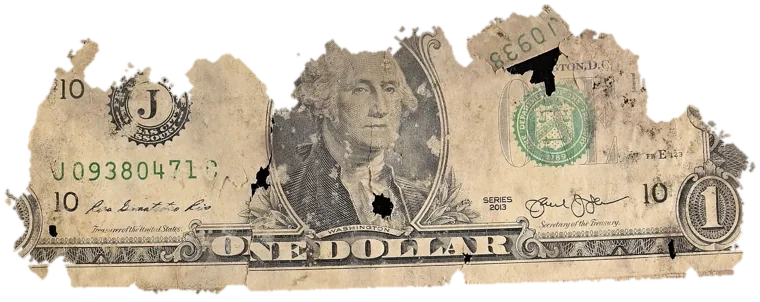
The words at the top say FEDERAL RESERVE NOTE: the note is technically a liability of the Federal Reserve, put into circulation by one of its 12 regional banks, named in the round seal on the left. But the object itself was manufactured by the Treasury's BEP, carries the Treasury's green seal on the right, and is signed by the Treasurer of the United States and the Secretary of the Treasury.
I met both halves of the system in one week. The bank (a private company inside the Federal Reserve's cash network) refused my moldy brick as contaminated currency, which is Federal Reserve rulebook territory. Then it promised the Treasury would send an exchange bag, because destroyed notes are the BEP's department. The Fed's system said no, and the Treasury's bag never came. Two institutions, one brick, zero dollars: an accidental civics lesson.
Related questions
Who actually prints US money?
The Bureau of Engraving and Printing, part of the Treasury, prints all US paper currency. The US Mint, also Treasury, makes coins.
Who decides how much money exists?
The Federal Reserve. It orders new notes from the BEP based on demand, issues them through its regional banks, retires worn notes, and steers the broader money supply through interest rates and monetary policy.
Is the Federal Reserve part of the government?
It is independent within the government: created by Congress, its Board members appointed by the President, but its policy decisions are made without requiring approval, and its 12 regional banks have a hybrid public-private structure.
Whose signatures are on my bill?
Two Treasury officials: the Treasurer of the United States and the Secretary of the Treasury. Their combination changes with administrations, which is one way collectors date notes.
The doorway
Everything on this page is illustrated with real dollars that spent two years underground.
See what nature made of themSOURCES · US Treasury: role and duties · Federal Reserve: about the Fed · UPDATED 2026-07-05